Thursday, 22 September 2016

In his Presence-Spiritual Perception


Carried Like Hot Coals of Fire

Leviticus 16:12 tells us that after the sacrifice had been presented on the Brazen Altar, the priests took a censor (a fancy, silver shovel) full of burning hot coals from that altar, and carried them into the Holy Place where they laid them on the Incense Altar.
The ritual of carrying the hot coals from the Brazen Altar to the Incense Altar connected the two altars. The hot coals of fire that fed the Brazen Altar were the same coals of fire that burned the incense on the Golden Altar. As we mentioned previously, the wholly burnt offering on the Brazen Altar testified of the acceptance of the offerer, just like the live coal on the Incense Altar demonstrated that all sin (and self) had been purged. The resulting incense cloud and aroma that then arose was pleasing to God.
The service of sanctification for the priests began by presenting a sacrifice on the Brazen Altar in the Inner Court and ended by the cloud of perfume rising towards God from the Incense Altar.
And the same analogy can be applied to us. Our sanctification begins with the offering of ourselves as a wholly burnt sacrifice on the Brazen Altar and ends with the cloud of incense and fragrance rising up before God’s presence at the Incense Altar.
God wants us to know Him, not just in our souls (where we experience His abundant Life through us), but also in our spirits (where we experience His presence and His fulness).
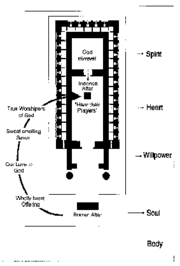
A layout of "the holy place".
He wants us to be like those priests who didn’t stop at the Brazen Altar, but carried those hot embers of a wholly burnt sacrifice right into the Holy Place and presented them there before God’s presence as a sweet smelling aroma. He wants us to willingly allow God to burn up all that He that He knows is necessary in our souls, so that we can boldly make our approach to Him in the Holy Place of our hearts.
The writer of Hebrews tells us: "Having, therefore, brethren, boldness to enter into the holiest by the blood of Jesus… Let us draw near [to God] with a true heart in full assurance of faith, having our hearts sprinkled from an evil conscience, and our bodies washed with pure water.” (Hebrews 10:1922)
Because of Jesus and what He has done for us, the way to the Holy Place has already been permanently opened and we are already clothed in His righteousness. But, in order for us to enter the Holy Place, we must be just like that sacrifice, wholly and completely burnt. 
Who shall ascend into the hill of the Lord? Or who shall stand in His Holy Place? He that hath clean hands, and a pure heart; Who hath not lifted up his soul unto vanity…” (Psalm 24:3-4)

The Journey Inward

If you have ever done a study of the Tabernacle, you will remember the floor plan of Solomon’s Temple and how God dwelt in the Holy of Holies, behind the veil.
Now, however, Scripture tells us God, the Holy Spirit, dwells in the Holy Place of our hearts. Because of Jesus’ death and resurrection on our behalf, the veil has been rent and the way to God opened. This means that believers now have free access to God at any time and may commune with Him as long as they like. This is not only our desire, but God’s desire also. The Old Testament tells us that He came precisely to dwell with us, to fellowship with us and to commune with us. This intimacy with God is said to take place at the deepest level of our being where God now dwells.
-----plans Purpose and Pursuit by Kenneth Hagin-------download
Some would call this inward journey towards experiential oneness with God in our spirit “Christian mysticism.” Mysticism simply means a soul in contact with or in union with God. Mysticism has had a very controversial history, although it did play a vital role in the early church. Listen to how theEncyclopedia Britannica expresses it, “The mystical aspect of early Christianity finds its fullest expression in the letters of Paul and the Apostle John. For Paul and John, the mystical experience always meant union with Christ. It was Paul’s supreme desire to know Christ and to be united with Him. Thus, the recurring phrase, ‘in Christ,’ [throughout Scripture] implies personal union, and a participation in Christ’s death and resurrection.”[1]
True Biblical mysticism is simply contacting God in the deepest part of our being where He now dwells. Christian mysticism, however, does not mean experientialism. It does not mean visions or voices or dreams, but simply an all-pervasive awareness of God’s presence. It means experiencing His nearness, His guidance, His revelations, His anointing, His Love, His Power, His peace and His joy. The only way to experience these things is not though techniques, introspection or experience, but humility, endurance and love for God.
The question that needs to be addressed then is: “Why are so many Christians running to and fro across the land trying to experience the presence of God if, all the time, He dwells within? Why don’t we simply turn our attention inward, not self-ward, but inward to where God permanently resides?”

As Fenelon said (400 years ago):
“All of us were made for God. But when people are told to seek God within, it’s like telling them to go to another planet! What is farther away and more unknown than the bottom of our own heart!”[2]I know how difficult it is in our busy, bustling and hustling lives, to abandon ourselves to God and seek to experience His presence. All the noise and clamor of our everyday lives try to constantly turn our attention elsewhere, and it becomes almost impossible to squeeze out time to spend with Him.
Jesus told us that we are “not of this world” and that our kingdom is still coming. Now this does notmean that we are to turn our back on life and take flight from the world by secluding and sequestering ourselves and seeking only Him. There are times that we must do so but, in general, He wants us to “occupy” by living the reality of this life. To occupy means “to dwell in or to reside in.” Jesus wants us to dwell in and reside in this world, but at the same time, always have an inner attitude of abandonment to His will. This is the “inward” love-relationship that God desires and the only thing that will bring us the “fulness of Christ” that we are searching for.
William Law expresses it so beautifully in his book The Spirit of Love: “The one true way of dying to self wants no monasteries or pilgrimages. It is the way of patience, humility and (total) resignation to God.” God’s primary purpose for each of us is to experience intimacy with Him, and then to share that Love with all those we come in contact with.
Is it possible in our modern times and our busy lives to live in constant communion and fellowship with God? Will He really teach, guide and commune with each of us personally? Can we actually meet with Him and dwell in His presence?
The Bible says we can, and we must. “Surely… the upright [the just, the righteous and the straight] shall dwell in Thy presence” (Psalm 140:13).

How Do We Get There?

The Psalms tell us that the only ones who are able to abide in His temple are those who have “clean hands, and a pure heart” and “that walketh uprightly, and… speaketh the truth” (Psalm 24:3-415:1-2). In other words, the only ones who will abide in God’s presence are the ones who are faithful, upright, just, holy and straight.
Blessed is the man whom Thou choosest, and causest to approach unto Thee, That he may dwell in the courts: we shall be satisfied with the goodness of Thy house, even of Thy holy temple. (Psalm 65:4)Once we accept Christ’s death on the cross on our behalf, Scripture says we are made “positionally” righteous, holy, just and upright. “Experientially,” however, it’s another story! (Naturally, we are far from being any of these things.) Therefore, since God is holy and cannot fellowship or commune with anything that is not holy, He must first make us holy through the sanctification process. “Having, therefore, these promises, dearly beloved, let us cleanse ourselves from all filthiness of the flesh and spirit, perfecting holiness in the fear of God” (2 Corinthians 7:1).
Something important to keep in mind is that the faithfulness, the uprightness and the holiness that are spoken of in these Scriptures are Christ’s, not our own. If our outer man (our soul) has been broken and our spirit purified and strengthened, then these attributes of God can also become ours. However, if the soulish things in our lives have not been cut away, separated and dis-united from the spiritual, then we won’t experience these things either.
Our journey inward towards “experiential” union with God is what the dark night is all about. This is the time that God burns up and melts away all our egotism and self-orientation and prepares us totally for Himself. All our own self-made strengths, self-oriented energies and self-centered activities must be consumed by His Love.
Again, the first thing we must remember is that only God can bring this union about. We are holy and pure only to the degree of “self” that we have allowed God to cut away. After “self” (for the most part) has been severed, no separation will remain between God and ourselves, and for the moment, we can experience “oneness” with Him.
Remember, our greatest failure is not recognizing who God is. He is Holy! Therefore, the only way we can approach Him is to become sanctified and holy. Anything short of His holiness will not be able to stand in His presence.

Notes

  1.  Encyclopaedia Britannica, Christianity: History of Christian Mysticism, Vol. 16, page 372.
  2.  Francois Fenelon, The Seeking Heart, p. 180
There is no other access or pathway to God. His death is the only thing that opens the door for us; however, in order to enter the inner sanctuary where God is and experience His presence, we must personally pass the place of sacrifice. Only the fire and hot coals were carried to the Incense Altar.
No self-interests or self-centeredness are allowed within the veil. Only as we surrender our own goals, our own careers, our own future successes and our own desires, does the crucifixion of self become complete. Only as we bring the coals of our wholly burnt lives into the Holy Place and place them upon the Incense Altar, can a sweet fragrance arise towards God. Our soul has finally been melted by the fire of God’s Love and we’re able to experience His presence and His fullness.
“I am crucified with Christ: nevertheless I live; yet not I, but Christ liveth in me; and the life which I now live in the flesh I live by the faith of the Son of God, who loved me and gave Himself for me.” (Galatians 2:20)Our intercourse or experiential union with God can only come through the two altars! The holy fire on the Incense Altar, which causes the perfume to ascend, is the same fire which consumed the sacrifice at the Brazen Altar. There is no other pathway to intimacy with God. God makes us one with Himself only through the fire.
“Behold, I have created the smith that bloweth the coals in the fire, and that bringeth forth an instrument for His work.…” (Isaiah 54:16)

Entering God’s Presence at the Incense Altar

The Golden Altar of Incense was at the heart of the temple and was considered to be the most holy piece of furniture (next to the Ark of the Covenant with its Mercy Seat covering in the Holy of Holies). The inscription on the Incense Altar said, “He ever liveth to make intercession for us.” The Golden Altar sat in the Holy Place just before the veil and, as we said, was called “the Altar before the Lord.” Thus, it was considered to be a part of, or belonging to, the Holy of Holies.
Listen: “And he shall take a censer full of burning coals of fire from off the altar before the Lord, and his hands full of sweet incense beaten small, and bring it within the veil. And he shall put the incense upon the fire before the Lord, that the cloud of the incense may cover the mercy seat that is upon the testimony….” (Leviticus 16:12-13)
This Golden Altar was a place of worship, communion and fellowship and opened the way to the Holy of Holies where God’s glory dwelt. There were no sacrifices on this altar, only the offering of incense.Incense was the result of a sacrifice already given. “For from the rising of the sun even unto the going down of the same, My Name shall be great among the Gentiles, and in every place incense shall be offered unto My Name, and a pure offering; for My Name shall be great among the heathen, saith the Lord of hosts.” (Malachi 1:11)
It was necessary to keep the fire on this altar continually burning to symbolize uninterrupted communion and worship of God. Thus, because they needed ready and easy access to this altar, they placed it in the Holy Place, as close as they could to the Holy of Holies. The priests had to offer incense three times a day as a fragrant memorial of the presence of God (in the morning, when they trimmed the lamps and at evening). Another reason this altar sat in the Holy Place and not in the Holy of Holies is because the High Priest was only allowed to go into the Holy of Holies once a year, on Yom Kippur [the Day of Atonement].
Incense is an aromatic compound that gives forth perfume or a sweet aroma by burning. The essence of the offering was dissolved into vapor and, thus, ascended as a cloud unto God. The perfume cloud symbolized the acceptance of the saint, his high standing and his potential communion with God.
Entering God’s presence at the Incense Altar of our hearts is contingent upon the sanctification of our outward man and the purification of our spirit. Jesus’ blood is what gives us the boldness to enter, butour sanctification is what allows us to experience His presence. The veil has already been rent, and so there is no more barrier hindering our approach to Him. However, again the basis of our fellowship is dependent upon the cutting away of the soulish things in our lives. As Hebrews 10:19 and 22 says, "Let us draw near with a true heart [a cleansed and purified heart] in full assurance of faith… [with] boldness to enter into the holiest…."
“And He shall sit like a refiner and purifier of silver; and He shall purify the sons of Levi, and purge them like gold and silver, that they may offer unto the Lord an offering in righteousness.” (Malachi 3:3 emphasis added)Jesus has always been before the Lord on our behalf. Romans 8:34 validates this. But now that we have been allowed into the Holy Place, we will be able to experience His presence going before us and giving us peace and rest.

The Place God Meets with Us

The Old Testament precept "Thou shall put it [the incense] before the veil that is by the ark of the testimony… where I will meet with You,” was fulfilled by putting the incense on the Golden Altar. (Exodus 30:636) And, we are enabled to “meet with God” when we bring the hot coals of our wholly burnt lives to the incense altar of our hearts.
One of the reasons why God has us in the sanctification process in the first place is so that He might bring us near to Him. Numbers 16:9 validates this: “Seemeth it but a small thing unto you, that the God of Israel hath separated you [consecrated you] from the congregation of Israel, to bring you near to Himself…”
Scripture tells us that “God will bring us near to Him” and “meet with us” at three different places: at the Ark of the Covenant (Exodus 25:22); at the Incense Altar (Exodus 30:636); and at the Brazen Altar (Exodus 29:42).
Therefore, even though we might “feel” abandoned and alone when we are going through our own night seasons, we must remember that God is always in the midst of the fire with us, just like He was with Moses, Jonah, Joseph, and Elijah. And just as He promised never to leave them, so He promises never to forsake us.

Wednesday, 21 September 2016

Sweet Influences of the Spirit


Sweet Influences of the Spirit
John 15:26Amplified Bible (AMP)
26 “But when the Helper (Comforter, Advocate, Intercessor—Counselor, Strengthener, Standby) comes, whom I will send to you from the Father, that is the Spirit of Truth who comes from the Father, He will testify and bear witness about Me.
We soak, we sow, and then the Spirit flows! This is how we experience God’s power in our lives.
Many Christians today have heard about the Holy Spirit, but they have not encountered him in a life-changing way. When we first ask Jesus into our lives, the Holy Spirit flows his life into our mortal bodies. The Spirit’s work begins in us when we first receive Christ into our lives: “If the Spirit of him who raised Jesus from the dead dwells in you, he who raised Christ Jesus from the dead will also give life to your mortal bodies through his Spirit who dwells in you” (Romans 8:11, ESV). This sets the stage for us to flow with the Spirit in our everyday lives. It is the Holy Spirit that gives us the power to overcome the sinful impulses of the flesh and the lures of the world that cause us to spend too much time on perishable aspects of this life.
This concept is so exciting because it takes us into a realm not bounded by the limitations of the world we see now. There is no limit to what God can do! No wonder Paul prayed, “Now to him who is able to do immeasurably more than all we ask or imagine, according to his power that is at work within us” (Ephesians 3:20). This is the resurrection power of Jesus Christ. No perceived earthly power can possibly be compared to this.
When we allow the Holy Spirit to control us, his power flows through us. The Holy Spirit is the only one who can make the converterlating process a reality in our lives. He is the One who enables us to participate with God to accomplish his work. Flowing with the Spirit is the supernatural outcome of soaking and sowing to the Spirit. It is the outcome of our relationship with God. The Holy Spirit is the divine power source, releasing the life and power of God into our lives when we are properly connected to him.
All of these truths become a reality in our lives when the Holy Spirit seals, reveals, and deals with us. The Holy Spirit first seals us at the point of our spiritual birth, “In him you also, when you heard the word of truth, the gospel of your salvation, and believed in him, were sealed with the promised Holy Spirit” (Ephesians 1:13, ESV, emphasis added). In Bible times, a seal was a type of security. It was typically used to guarantee a document or letter, indicate ownership, or protect against tampering. The Holy Spirit is our seal in every sense of this word; we are guaranteed, owned, and protected!The assurance that we experience because of the Holy Spirit’s seal sets us free to be Converterlators in the time we have remaining in this temporary world.
After the Holy Spirit seals us, he begins to reveal the things of God to us. In 1 Corinthians 2:10–16 we read:

These are the things God has revealed to us by his Spirit. The Spirit searches all things, even the deep things of God. For who knows a person’s thoughts except their own spirit within them? In the same way no one knows the thoughts of God except the Spirit of God. What we have received is not the spirit of the world, but the Spirit who is from God, so that we may understand what God has freely given us. This is what we speak, not in words taught us by human wisdom but in words taught by the Spirit, explaining spiritual realities with Spirit-taught words. The person without the Spirit does not accept the things that come from the Spirit of God but considers them foolishness, and cannot understand them because they are discerned only through the Spirit. The person with the Spirit makes judgments about all things, but such a person is not subject to merely human judgments, for, ‘Who has known the mind of the Lord so as to instruct him?’ But we have the mind of Christ.
The Holy Spirit opens our hearts to spiritual truth. This gives us the ability to both understand and respond to God’s calling as we converterlate our time, talent, and treasure.
As the Holy Spirit reveals the things of God to us, he also deals with us. Jesus said, “It is the Spirit who gives life” (John 6:63, ESV). We choose to live under his control. It is through the Holy Spirit that God works in us and through us, “For it is God who works in you to will and to act in order to fulfill his good purpose” (Philippians 2:13). It is the Holy Spirit’s power that allows us to serve God’s purposes in God’s way.
When we flow with the Spirit we experience his power as we navigate our way through everyday decisions and experiences: “You will receive power when the Holy Spirit comes on you” (Acts 1:8). It is the Holy Spirit that guides our lives daily: “If we live by the Spirit, let us also keep in step with the Spirit” (Galatians 5:25, ESV).
When we invite the Holy Spirit to guide and direct and lead us, he shows up in a big way! He transforms us and everything that we do … including our converterlating! He fills us daily and equips us for service. He gives us joy and excitement and fulfillment. He draws us into a deeper relationship with God. He gives us insight into God’s Word. He leads us to victorious living. The effective Converterlator is filled with the Holy Spirit and depends on his power and wisdom to accomplish all that God desires!
If you truly allow the Holy Spirit to flow in your life, how might your converterlating be changed, focused, or redirected?

Tuesday, 20 September 2016

Ministerial advice on Ministry by Charles finney


A WISE MINISTER WILL BE SUCCESSFUL

 TEXT. --He that winneth souls is wise. --PROVERBS xi. 30.
I PREACHED last Friday evening from the same text, on the method of dealing with sinners by private Christians. My object at this time is to take up the more public means of grace, with particular reference to the
DUTIES OF MINISTERS.
As I observed in my last lecture, wisdom is the choice and pursuit of the best end by the most appropriate means. The great end for which the Christian Ministry was appointed, is to glorify God in the salvation of souls. In speaking on this subject I propose to show,
I. That a right discharge of the duties of a minister requires great wisdom.
II. That the amount of success in the discharge of his duties (other things being equal) decides the amount of wisdom employed by him in the exercise of his office.
I. I am to show that a right discharge of the duties of a minister requires great wisdom.
1. On account of the opposition it encounters. The very end for which the ministry is appointed is one against which is arrayed the most powerful opposition of sinners themselves. If men were willing to receive the Gospel, and there were nothing needed to be done but to tell the story of redemption, a child might convey the news. But men are opposed to the Gospel. They are opposed to their own salvation, in this way. Their opposition is often violent and determined. I once saw a maniac who had formed designs against his own life, and he would exercise the utmost sagacity and cunning to effect his purpose. He would be as artful and make his keepers believe he had no such design, that he had given it all up, and would appear as mild and sober, and at the instant the keeper was off his guard he would lay hands on himself. So sinners often exercise great cunning in evading all the efforts that are made to save them. And to meet this dreadful cunning, and overcome it so as to save men, ministers need a great amount of wisdom.
2. The particular means appointed to be employed in the work show the necessity of great wisdom in ministers. If men were converted by an act of physical omnipotence, creating some new taste, or something like that, and if sanctification were nothing but the same physical omnipotence rooting out the remaining roots of sin from the soul, it would not require so much sagacity and skill to win souls. Nor would there then be any meaning in the text. But the truth is that regeneration and sanctification are to be effected by moral means--by argument and not by force. There never was and never will be any one saved by any thing but truth as the means. Truth is the outward means, the outward motive, presented first by man and then by the Holy Spirit. Take into view the opposition of the sinner himself, and you see that nothing, after all, short of the wisdom of God and the moral power of the Holy Spirit, can break down this opposition, and bring him to submit to God. Still the means are to be used by men, and means adapted to the end, skillfully used. God has provided that the work of conversion and sanctification shall in all cases be done by means of that kind of truth, applied in that connection and relation, which is fitted to produce such a result.
3. He has the powers of earth and hell to overcome, and that calls for wisdom. The devil is constantly at work, trying to prevent the success of ministers, laboring to divert the attention from the subject of religion, and to get the sinner away from God and lead him down to hell. The whole framework of society, almost, is hostile to religion. Nearly all the influences which surround a man from his cradle to his grave, in the present state of society, are calculated to defeat the design of the ministry. Does not a minister then need great wisdom to conflict with the powers of darkness, and the whole influence of the world, in addition to the sinner's own opposition?
4. The same is seen from the infinite importance of the end itself. The end of the ministry is the salvation of the soul. When we consider the importance of the end, and the difficulties of the work, who will not say with the apostle, "Who is sufficient for these things?"
5. He must understand how to wake up the church, and get them out of the way of the conversion of sinners. This is often the most difficult part of a minister's work, and requires more wisdom and patience than any thing else. Indeed, to do this successfully, is a most rare qualification in the Christian ministry. It is a point where almost all ministers fail. They know not how to wake up the church, and raise the tone of piety to a high standard, and thus clear the way for the work of conversion. Many ministers can preach to sinners very well, but gain little success, while the counteracting influence of the church resists it all, and they have not skill enough to remove the difficulty. There is only here and there a minister in the country who knows how to probe the church when they are in a cold, backslidden state, so as effectually to wake them up and keep them awake. The members of the church sin against such light, that when they become cold it is very difficult to rouse them up. They have a form of piety which wards off the truth, while at the same time it is just that kind of piety which has no power nor efficiency. Such professors are the most difficult individuals to arouse from their slumbers. I do not mean that they are always more wicked than the impenitent. They are often employed about the machinery of religion, and pass for very good Christians, but are of no use in a revival.
I know ministers are sometimes amazed to hear it said that churches are not awake. No wonder such ministers do not know how to wake a sleeping church. There was a young licentiate heard brother Foote the other day, in this city, pouring out truth, and trying to wake up the churches, and he knew so little about it that he thought it was abusing the churches. So perfectly blind was he that he really thought the churches in New York were all awake on the subject of religion. So some years ago there was a great controversy and opposition raised, because so much was said about the churches being asleep. It was all truth, yet many ministers knew nothing about it, and were astonished to hear such things said about the churches. When it has come to this, that ministers do not know when the church is asleep, no wonder that we have no revivals. I was invited once to preach at a certain place. I asked the minister what was the state of the church. "Oh," says he, "to a man they are awake." I was delighted at the idea of laboring in such a church, for it was a sight I had never yet seen, to see every single member awake in a revival. But when I got there I found the church sleepy and cold, and I doubt whether one of them was awake.
Here is the great difficulty in keeping up revivals, to keep the church thoroughly awake and engaged. It is one thing for a church to get up in their sleep and bluster about and run over each other, and a widely different thing for them to have their eyes open, and their senses about them, and be wide awake, so as to know how to find God and how to work for Christ.
6.* He must know how to set the church to work when they are awake. If a minister attempts to go to work alone, calculating to do it all himself, it is like attempting to roll a great stone up a hill alone. The church can do much to help forward a revival. Churches have sometimes had powerful revivals without any minister. But when a minister has a church who are awake, and knows how to set them to work, and how to sit at the helm and guide them, he may feel strong, and oftentimes may find that they do more than he does himself, in the conversion of sinners.
7. In order to be successful, a minister needs great wisdom to know how to keep the church to the work. Often the church seem just like children. You set children to work, and they appear to be all engaged, but as soon as your back is turned they will stop and go to play. The great difficulty in continuing a revival lies here. And to meet it requires great wisdom. To know how to break them down again, when their heart gets lifted up because they have had such a great revival; to wake them up afresh when their zeal begins to flag; to keep their hearts full of zeal for the work; these are some of the most difficult things in the world. Yet if a minister would be successful in winning souls, he must know when they first begin to grow proud, or to lose the spirit of prayer, and when to probe them and how to search them over again, how to keep the church in the field gathering the harvest of the Lord.
8. He must understand the Gospel. But you will ask, Do not all ministers understand the Gospel? I answer, that they certainly do not all understand it alike, for they do not all preach alike.
9. He must know how to divide it, so as to bring forward the particular truths, in that order, and to make them bear upon those points and at such times as are calculated to produce a given result. A minister should understand the philosophy of the human mind, so as to know how to plan and arrange his labors wisely. Truth, when brought to bear upon the mind, is in itself calculated to produce corresponding feelings. The minister must know what feelings he wishes to produce, and how to bring such truth to bear as is calculated to produce these feelings. He must know how to present truth calculated to humble Christians, or to make them feel for sinners, or to awaken sinners, or to convert them.
Often, when sinners are awakened, the ground is lost for the want of wisdom in following up the blow. Perhaps a rousing sermon is preached, Christians are moved, and sinners begin to feel, and the next Sabbath something will be brought forward that has no connection with the state of feeling in the congregation, and that is not calculated to lead the mind on to the exercise of repentance, faith or love. It shows how important it is that a minister should understand how to produce a given impression, at what time it may and should be done, and by what truth, and how to follow it up, till the sinner is broken down and brought in.
A great many good sermons preached are all lost for the want of a little wisdom here. They are good sermons, and calculated, if well timed, to do great good; but they have so little connection with the actual state of feeling in the congregation, that it would be more than a miracle if they should produce a revival. A minister may preach in this random way till he has preached himself to death, and never produce any great results. He may convert here and there a scattering soul; but he will not move the mass of the congregation unless he knows how to follow up his impressions, to carry out a plan of operations and execute it, so as to carry on the work when it is begun. He must not only be able to blow the trumpet so loud as to start the sinner from his lethargy, but when he is waked, he must lead him by the shortest way to Jesus Christ. And not as soon as sinners are roused by a sermon, immediately begin to preach about some remote subject that has no tendency to carry on the work.
10. To reach different classes of sinners successfully requires great wisdom on the part of a minister. For instance, a sermon on a particular subject may start a particular class of persons among his hearers. Perhaps they will begin to look serious, or perhaps talk about it, or perhaps they will begin to cavil about it. Now, if the minister is wise, he will know how to observe those indications, and to follow right on with sermons adapted to this class, until he leads them into the kingdom of God. Then let him go back and take another class, find out where they are hid, break down their refuges, and follow them up, till he leads them into the kingdom of God. He should thus beat about every bush where sinners hide themselves, as the voice of God followed Adam in the garden--"ADAM, WHERE ART THOU?" till one class of hearers after another are brought in, and so the whole community converted. Now a minister must be very wise to do this. It never will be done so, till a minister sets himself to hunt out and bring in every class of sinners in his congregation, the old and young, male and female, rich and poor.
11. A minister needs great wisdom to get sinners away from their present refuges of lies, without forming new hiding places for them. I once sat under the ministry of a man who had contracted a great alarm about heresies, and was constantly employed in confuting them. And he used to bring up many such heresies as his people never heard of. He got his ideas chiefly from books, and mingled very little among the people to know what they thought. And the result of his labors often was, that the people would be taken with the heresy, more than with the argument against it. The novelty of the error attracted their attention so much that they forgot the answer. And in that way he gave many of his people new objections against religion, such as they never thought of before. If a man does not mingle enough with mankind to know how people think now-a-days he cannot expect to be wise to meet their objections and difficulties.
I have heard a great deal of preaching against Universalists, that did more hurt than good, because the preachers did not understand how Universalists of the present day reason. They have never mingled with Universalists, and know not what they believe and how they argue, now, but have got all they know of Universalism from books that were written long ago, and are now out of date among Universalists themselves. And the consequence is that when they attempt to preach against Universalism they oppose a man of straw, and not Universalist sentiments as they are now found in the community. And people either laugh at them, or say it is all lies, for they know Universalists do not hold such sentiments as are ascribed to them by the preacher.
When ministers undertake to oppose a present heresy, they ought to know what it is at present. For instance, almost all those who write and preach against Universalism think they are called upon to oppose the idea that God is all mercy. They suppose Universalists hold the doctrine that God is all mercy, and that when they have refuted this doctrine, they have got Universalists down. But this is not true. They do not hold such doctrine. They deny it altogether. They reject the idea of mercy in the salvation of men, for they hold that every man is punished in full according to his just deserts. Of what use is it, then, to argue against Universalists, that God is a God of justice and not a God all mercy, when they hold to the justice of God alone as the ground of salvation, and do not admit the idea of mercy at all? In like manner, I have heard men preach against the idea that men are saved in their sins, and they supposed they were preaching down Universalist doctrine. Universalists believe no such thing. They believe that all men will be made holy and saved in that way. This shows the importance of knowing what people actually hold, before you try to reason them out of their errors. It is of no use to misrepresent a man's doctrines to his face, and then try to reason him out of them. You must state his doctrine just as he holds it, and state his arguments fairly. Otherwise, if you state them wrong, you either make him angry, or he laughs in his sleeve at the advantage you give him. He will say, That man cannot argue with me on fair grounds; he has to misrepresent our doctrines in order to confute me. Great hurt is done in this way. Ministers do not intend to misrepresent their opponents; but the effect of it is, that the poor miserable creatures who hold these errors go to hell because ministers do not take care to inform themselves what are their real errors. Errors are never torn away by such a process. I mention these cases to show how much wisdom a minister must have to meet the cases that occur. He must be acquainted with the real views of men in order to meet them, and do away their errors and mistakes.
12. Ministers ought to know what measures are best calculated to aid in accomplishing the great end of their office, the salvation of souls. Some measures are plainly necessary. By measures, I mean what things should be done to get the attention of the people and bring them to listen to the truth. Building houses for worship, and visiting from house to house, etc., are all "measures," the object of which is to get the attention of people to the Gospel. Much wisdom is requisite to devise and carry forward all the various measures that are adapted to favor the success of the Gospel.
What do the politicians do? They get up meetings; circulate handbills and pamphlets; blaze away in the newspapers; send their ships about the streets on wheels with flags and sailors; send coaches all over town, with handbills, to bring people up to the polls--all to gain attention to their cause and elect their candidate. All these are their "measures," and for their end they are wisely calculated. The object is to get up an excitement, and bring the people out. They know that unless there can be an excitement it is in vain to push their end, I do not mean to say that their measures are pious, or right, but only that they are wise, in the sense that they are the appropriate application of means to the end.
The object of the ministry is to get all the people to feel that the devil has no right to rule this world, but that they ought all to give themselves to God, and vote in the Lord Jesus Christ as the governor of the universe. Now what shall be done? What measures shall we take? Says one, "Be sure and have nothing that is new." Strange! The object of our measures is to gain attention, and you must have something new. As sure as the effect of a measure becomes stereotyped, it ceases to gain attention, and then you must try something new. You need not make innovations in everything. But whenever the state of things is such that anything more is needed, it must be something new, otherwise it will fail. A minister should never introduce innovations that are not called for. If he does they will embarrass him. He cannot alter the Gospel; that remains the same. But new measures are necessary, from time to time, to awaken attention and bring the Gospel to bear upon the public mind. And then a minister ought to know how to introduce new things, so as to create the least possible resistance or reaction. Mankind are fond of form in religion. They love to have their religious duties stereotyped, so as to leave them at ease; and they are therefore inclined to resist any new movement designed to rouse them up to action and feeling. Hence it is all-important to introduce new things wisely, so as not to give needless occasion or apology for resistance.
13. Not a little wisdom is sometimes needed by a minister to know when to put a stop to new measures. When a measure has novelty enough to secure attention to the truth, ordinarily no other new measure should be introduced. You have secured the great object of novelty. Anything more will be in danger of diverting the public mind away from the great object, and fixing it on the measures themselves. And then, if you introduce novelties when they are not called for, you will go over so large a field, that by and by when you really want something new, you will have nothing else to introduce, without doing something that will give too great a shock to the public mind. The Bible has laid down no specific course of measures to promote revivals of religion, but has left it to ministers to adopt such as are wisely calculated to secure the end. And the more sparing we are of our new things, the longer we can use them, to keep public attention awake to the great subject of religion. By a wise course this may undoubtedly be done for a long series of years, until our present measures will by and by have sufficient novelty in them again to attract and fix public attention. And so we shall never want for something new.
14. A minister, to win souls, must know how to deal with careless, with awakened, and with anxious sinners, so as to lead them right to Christ in the shortest and most direct way. It is amazing to see how many ministers there are who do not know how to deal with sinners, or what to say to them in their various states of mind. A good woman in Albany told me, that when she was under concern she went to her minister and asked him to tell her what she must do to get relief. And he said God had not given him much experience on the subject, and advised her to go to such a deacon, who perhaps could tell her what to do. The truth was, he did not know what to say to a sinner under conviction, although there was nothing peculiar in her case. Now if you think this minister a rare case, you are quite deceived. There are many ministers who do not know what to say to sinners.
A minister once appointed an anxious meeting, and went to attend it, and instead of going round to the individuals, he began to ask them the catechism, "Wherein doth Christ execute the office of a priest?" About as much in point to a great many of their minds as anything else.
I know a minister who held an anxious meeting, and went to attend it with a written discourse which he had prepared for the occasion. Just as wise as it would be if a physician, going out to visit his patients, should sit down at leisure and write all the prescriptions before he had seen them. A minister needs to know the state of mind of the individuals, before he can know what truth will be proper and useful to administer. I say these things, not because I love to do it, but because truth, and the object before me, requires them to be said. And such instances as I have mentioned are by no means rare.
A minister should know how to apply truth to all the situations in which he may find dying sinners going down to hell. He should know how to preach, how to pray, how to conduct prayer-meetings, and how to use all the means for bringing the truth of God to bear upon the kingdom of darkness. Does not this require wisdom? And who is sufficient for these things?
II. The amount of a minister's success in winning souls (other things being equal) invariably decides the amount of wisdom he has exercised in the discharge of his office.
1. This is plainly asserted in the text. "He that winneth souls is wise." That is, if a man wins souls, he does skillfully adapt means to the end, which is, to exercise wisdom. He is the more wise, by how much the greater is the number of sinners that he saves. A blockhead may, indeed, now and then stumble on such truth or such a manner of exhibiting it, as to save a soul. It would be a wonder indeed if any minister did not sometimes have something in his sermons that would meet the case of some individual. But the amount of wisdom is to be decided, "other things being equal," by the number of cases in which he is successful in converting sinners.
Take the case of a physician. The greatest quack in New York may now and then stumble upon a remarkable cure, and so get his name up with the ignorant. But sober and judicious people judge of the skill of a physician by the uniformity of his success in overcoming disease, the variety of diseases he can manage, and the number of cases in which he is successful in saving his patients. The most skillful saves the most. This is common sense. It is truth. And it is just as true in regard to success in saving souls, and true in just the same sense.
2. This principle is not only asserted in the text, but it is a matter of fact, a historical truth, that "He that winneth souls is wise." He has actually employed means adapted to the end, in such a way as to secure the end.
3. Success in saving souls is evidence that a man understands the Gospel, and understands human nature, that he knows how to adapt means to his end, that he has common sense, and that he has that kind of tact, that practical discernment, to know how to get at people. And if his success is extensive, it shows that he knows how to deal with a great variety of characters, in a great variety of circumstances, who are yet all the enemies of God, and to bring them to Christ. To do this requires great wisdom. And the minister who does it shows that he is wise.
4. Success in winning souls shows that a minister not only knows how to labor wisely for that end, but also that he knows where his dependence is. You know that fears are often expressed respecting those ministers who are aiming most directly and earnestly at the conversion of sinners. People say, "Why, this man is going to work in his own strength; one would imagine he thinks he can convert himself." How often has the event showed that the man knows what he is about, very well, and knows where his strength is too. He went to work to convert sinners so earnestly, just as if he could do it all himself; but that was the very way he should do. He ought to reason with sinners, and plead with them, as faithfully and fully as if he did not expect any interposition of the Spirit of God, or as if he knew there was no Holy Ghost. But whenever a man does this successfully, it shows that, after all, he knows he must depend on the Spirit of God alone for success.
OBJECTION.--There are many who feel an objection against this subject, arising out of the view they have taken of the ministry of Jesus Christ. They ask us, "What will you say about the ministry of Jesus Christ, was not he wise?" I answer, Yes, infinitely wise. But in regard to his alleged want of success in the conversion of sinners, you will observe the following things:
(1.) That his ministry was vastly more successful than is generally supposed. We read in one of the sacred writers, that after his resurrection and before his ascension "he was seen by above five hundred brethren at once." If so many as five hundred brethren were found assembled together at one place, we see there must have been a vast number of them scattered over the country.
(2.) Another circumstance to be observed is, that his public ministry was very short, less than three years.
(3.) Consider the peculiar design of his ministry. His main object was to make atonement for the sins of the world. It was not aimed so much at promoting revivals. The "dispensation of the Spirit" was not yet given. He did not preach the Gospel so fully as his apostles did afterwards. The prejudices of the people were so fixed and violent that they would not bear it. That he did not, is plain from the fact that even his apostles, who were constantly with him, did not understand the atonement. They did not get the idea that he was going to die, and consequently, when they heard he was actually dead, they were driven to despair, and thought the thing was all gone by, and their hopes blown to the winds. The fact was, that he had another object in view, to which every thing else was made to yield, and the perverted state of the public mind, and the obstinate prejudices prevailing, showed why results were not seen any more in the conversion of sinners. The state of public opinion was such, that they finally murdered him for what he did preach.
Many ministers who have little or no success, are hiding themselves behind the ministry of Jesus Christ, as if he was an unsuccessful preacher. Whereas, in fact, he was eminently successful, considering the circumstances in which he labored. This is the last place in all the world where a minister who has no success should think of hiding himself.
REMARKS.
1. A minister may be very learned and not wise. There are many ministers possessed of great learning; they understand all the sciences, physical, moral, and theological; they may know the dead languages, and possess all learning, and yet not be wise, in relation to the great end about which they are chiefly employed. Facts clearly demonstrate this. "He that winneth souls is wise."
2. An unsuccessful minister may be pious as well as learned, and yet not wise. It is unfair to infer because a minister is unsuccessful, that therefore he is a hypocrite. There may be something defective in his education, or in his mode of viewing a subject, or of exhibiting it, or such a want of common sense, as will defeat his labors, and prevent his success in winning souls, while he himself may be saved--"yet so as by fire."
3. A minister may be very wise, though he is not learned. He may not understand the dead languages, or theology in its common acceptation; and yet he may know just what a minister of the Gospel wants most to know, without knowing many other things. A learned minister and a wise minister are different things. Facts in the history of the church in all ages prove this. It is very common for churches, when looking out for a minister, to aim at getting a very learned man. Do not understand me to disparage learning. The more learning the better, if he is also wise in the great matter he is employed about. If a minister knows how to win souls, the more learning he has the better. But if he has any other kind of learning, and not this, he will infallibly fail of the end of his ministry.
4. Want of success in a minister (other things being equal) proves, (1.) either that he was never called to preach, and has taken it up out of his own head; or (2.) that he was badly educated, and was never taught the very things he wants most to know; or (3.) if he was called to preach, and knows how to do his duty, he is too indolent and too wicked to do it.
5. Those are the best educated ministers, who win the most souls. Ministers are sometimes looked down upon, and called very ignorant, because they do not know sciences and languages; although they are very far from being ignorant of the great thing for which the ministry is appointed. This is wrong. Learning is important, and always useful. But after all, a minister may know how to win souls to Christ, without great learning, and he has the best education for a minister, who can win the most souls to Christ.
6. There is evidently a great defect in the present mode of educating ministers. This is a SOLEMN FACT, to which the attention of the whole church should be distinctly called; that the great mass of young ministers who are educated accomplish very little.
When young men come out from the seminaries, are they fit to go into a revival? Look at a place where there has been a revival in progress, and a minister is wanted. Let them send to a theological seminary for a minister. Will he enter into the work, and sustain it, and carry it on? Seldom. Like David with Saul's armor, he comes in with such a load of theological trumpery, that he knows nothing what to do. Leave him there for two weeks, and the revival is at an end. The churches know and feel, that the greater part of these young men do not know how to do anything that needs to be done for a revival, and they are complaining that the young ministers are so far behind the church. You may send all over the United States, to theological seminaries, and find but few young ministers fitted to carry forward the work. What a state of things!
There is a grand defect in educating ministers. Education ought to be such, as to prepare young men for the peculiar work to which they are destined. But instead of this, they are educated for any thing else. The grand mistake is this. They direct the mind too much to irrelevant matters, which are not necessary to be attended to. In their courses of study, they carry the mind over too wide a field, which diverts their attention from the main thing, and so they get cold in religion, and when they get through, instead of being fitted for their work, they are unfitted for it. Under pretence of disciplining the mind, they in fact scatter the attention, so that when they come to their work, they are awkward, and know nothing how to take hold, or how to act, to win souls. This is not universally the case, but too often it is so.
It is common for people to talk loudly and largely about an educated ministry. God forbid that I should say a word against an educated ministry. But what do we mean by an education for the ministry? Do we mean that they should be so educated, as to be fitted for the work? If they are so educated, the more education the better. Let education be of the right kind, teaching a young man the things he needs to know, and not the very things he does not need to know. Let them be educated for the work. Do not let education be such, that when young men come out, after spending six, eight, or ten years in study, they are not worth half as much as they were before they went. I have known young men come out after what they call "a thorough course," who were not fit to take charge of a prayer meeting, and who could not manage a prayer meeting, so as to make it profitable or interesting. An elder of a church in a neighboring city, informed me recently of a case in point. A young man, before he went to the seminary, had labored as a layman with them, conducted their prayer meetings, and had been exceedingly useful among them. After he had been to the seminary, they sent for him and desired his help; but oh, how changed! he was so completely transformed, that he made no impression; the church soon began to complain that they should die under his influences, and he left, because he was not prepared for the work.
It is common for those ministers who have been to the seminaries, and are now useful, to affirm that their course of studies there did them little or no good, and that they had to unlearn what they had there learned, before they could effect much. I do not say this censoriously, but it is a solemn fact, and I must say it in love.
Suppose you were going to make a man a surgeon in the navy. Instead of sending him to the medical school to learn surgery, would you send him to the nautical school to learn navigation? In this way, you might qualify him to navigate a ship, but he is no surgeon. Ministers should be educated to know what the Bible is, and what the human mind is, and know how to bring one to bear on the other. They should be brought into contact with mind, and made familiar with all the aspects of society. They should have the Bible in one hand, and the map of the human mind in the other, and know how to use the truth for the salvation of men.
7. A want of common sense often defeats the ends of the Christian ministry. There are many good men in the ministry, who have learning, and talents of a certain sort, but they have no common sense to win souls.
8. We see one great defect in our theological schools.--Young men are shut up in their schools, confined to books and shut out from intercourse with the common people, or contact with the common mind, Hence they are not familiar with the mode in which common people think. This accounts for the fact that some plain men, that have been brought up to business, and acquainted with human nature, are ten times better qualified to win souls than those who are educated on the present principle, and are in fact ten times as well acquainted with the proper business of the ministry. These are called "uneducated men." This is a grand mistake. They are not learned in science, but they are learned in the very things which they need to know as ministers. They are not ignorant ministers, for they know exactly how to reach the mind with truth. They understand the minds of men, and how to adapt the gospel to their case. They are better furnished for their work, than if they had all the machinery of the schools.
I wish to be understood. I do not say that I would not have a young man go to school. Nor would I discourage him from going over the field of science. The more the better, if together with it he learns also the things that the minister needs to know, in order to win souls--if he understands his Bible, and understands human nature, and knows how to bring the truth to bear, and how to guide and manage minds, and to lead them away from sin and lead them to God.
9. The success of any measure designed to promote a revival of religion, demonstrates its wisdom with the following exceptions:
(1.) A measure may be introduced for effect to produce excitement, and be such that when it is looked back upon afterwards, it will look nonsensical, and appear to have been a mere trick. In that case, it will react, and its introduction will do more hurt than good.
(2.) Measures may be introduced, and the revival be very powerful, and the success be attributed to the measures, when in fact other things made the revival powerful, and these very measures may have been a hinderance.[sic.] The prayers of Christians, and the preaching, and other things may have been so well calculated to carry on the work, that it has succeded[sic.] in spite of these measures.
But when the blessing evidently follows the introduction of the measure itself, the proof is unanswerable, that the measure is wise. It is profane to say that such a measure will do more hurt than good. God knows about that. His object is, to do the greatest amount of good possible. And of course he will not add his blessing to a measure that will do more hurt than good. He may sometimes withhold his blessing from a measure that is calculated to do some good because it will be at the expense of a greater good. But he never will bless a pernicious proceeding. There is no such thing as deceiving God in the matter. He knows whether a given measure is, on the whole, wise, or not. He may bless a course of labours notwithstanding some unwise or injurious measures. But if he blesses the measure itself, it is rebuking God to pronounce it unwise. He who undertakes to do this, let him look to the matter.
10. It is evident that much fault has been found with measures, which have been pre-eminently and continually blessed of God for the promotion of revivals. We know it is said that the horrid oaths of a profane swearer have been the means of awakening another less hardened sinner. But this is a rare case. God does not usually make such a use of profanity. But if a measure is continually or usually blessed, let the man who thinks he is wiser than God, call it in question. TAKE CARE how you find fault with God!
11. Christians should pray for ministers. Brethren, if you felt how much ministers need wisdom to perform the duties of their great office with success, and how ignorant they all are, and how insufficient they are of themselves, to think anything as of themselves, you would pray for them a great deal more than you do; that is, if you cared anything for the success of their labors. People often find fault with ministers, when they do not pray for them. Brethren, this is tempting God, for you ought not to expect any better ministers, unless you pray for them. And you ought not to expect a blessing on the labors of your minister, or to have your families converted by his preaching, where you do not pray for him. And so for others, the waste places, and the heathen, instead of praying all the time, only that God would sent out more laborers, you have need to pray that God would make ministers wise to win souls, and that those he sends out may be properly educated, so that they shall be scribes well instructed in the kingdom of God.
12. Those laymen in the church who know how to win souls are to be counted wise. They should not be called "Ignorant laymen." And those church members who do not know how to convert sinners, and who cannot win souls, should not be called wise--as Christians. They are not wise Christians; only "he that winneth souls is wise." They may be learned in politics, in all sciences, or they may be skilled in the management of business, or other things, and they may look down on those who win souls, as nothing but plain, simple-hearted and ignorant men. If any of you are inclined to do this, and to undervalue those brethren who win souls, as being not so wise and cunning as you are, you deceive yourselves. They may not know some things which you know. But they know those things which a Christian is most concerned to know, and you do not.
It may be illustrated by the case of a minister that goes to sea. He may be learned in science, but he knows nothing how to sail a ship. And he begins to ask the sailors about this thing and that, and what is this rope for, and the like. "Why," say the sailors, "these are not ropes, we have only one rope in a ship, these are the rigging, the man talks like a fool." And so this learned man becomes a laughing-stock, perhaps, to the sailors, because he does not know how to sail a ship. But if he were to tell them one half of what he knows about science, perhaps they would think him a conjurer, to know so much. So learned students may understand their hic, hœc, hoc, very well, and may laugh at the humble Christian, and call him ignorant, although he may know how to win more souls than five hundred of them.
I was once distressed and grieved at hearing a minister bearing down upon a young preacher, who had been converted under remarkable circumstances, and who was licensed to preach without pursuing a regular course of study. This minister, who was never, or at least rarely, known to convert a soul, bore down upon the young man in a very lordly, censorious manner, depreciating him because he had not had the advantage of a liberal education, when in fact he was instrumental in converting more souls than any five hundred ministers like himself.
I would say nothing to undervalue, or lead you to undervalue a thorough education for ministers. But I do not call that a thorough education, which they get in our colleges and seminaries. It does not fit them for their work. I appeal to all experience, whether our young men in seminaries are thoroughly educated for the purpose of winning souls. DO THEY DO IT? Everybody knows they do not. Look at the reports of the Home Missionary Society. If I recollect right, in 1830, the number of conversions in connection with the labors of the missionaries of that society did not exceed five to each missionary. I believe the number has increased since, but is still exceedingly small to what it would have been had they been fitted by a right course of training for their work. I do not say this to reproach them, for from my heart I pity them, and I pity the church for being under the necessity of supporting ministers so trained, or none at all. They are the best men the Missionary Society can obtain. I suppose, of course, that I shall be reproached for saying this. But it is too true and too painful to be concealed. Those fathers who have the training of our young ministers are good men, but they are ancient men, men of another age and stamp, from what is needed in these days of excitement, when the church and world are rising to new thought and action. Those dear fathers will not, I suppose, see this; and will perhaps think hard of me for saying it; but it is the cause of Christ. Some of them are getting back toward second childhood, and ought to resign, and give place to younger men, who are not rendered physically incapable, by age, of keeping pace with the onward movements of the church. And here I would say, that to my own mind, it appears evident, that unless our theological professors preach a good deal, mingle much with the church, and sympathize with her in all her movements, it is morally, if not naturally, impossible, that they should succeed in training young men to the spirit of the age. It is a shame and a sin, that theological professors, who preach but seldom, who are withdrawn from the active duties of the ministry, should sit in their studies and write their letters, advisory, or dictatorial, to ministers and churches who are in the field, and who are in circumstances to judge what needs to be done. The men who spend all or at least a portion of their time in the active duties of the ministry, are the only men who are able to judge of what is expedient or inexpedient, prudent or imprudent, as to measures from time to time. It is as dangerous and ridiculous for our theological professors, who are withdrawn from the field of conflict, to be allowed to dictate, in regard to the measures and movements of the church, as it would be for a general to sit in his bed-chamber and attempt to order a battle. (This was said in 1833)
Two ministers were one day conversing about another minister whose labors were greatly blessed in the conversion of some thousands of souls. One of them said, "That man ought not to preach any more; he should stop and go to" a particular theological seminary which he named, "and go through a regular course of study." He said the man had "a good mind, and if he was thoroughly educated, he might be very useful," The other replied, "Do you think he would be more useful for going to that seminary? I challenge you to show by facts that any are more useful who have been there. No, sir, the fact is, that since this man has been in the ministry, he has been instrumental in converting more souls than all the young men who have come from that seminary in the time." This is logic! Stop, and go to a seminary, to prepare himself for converting souls, when he is now converting more than all who come from the seminary!
FINALLY.--I wish to ask you, before I sit down, who among you can lay any claim to the possession of this Divine wisdom? Who among you, laymen? Who among you, ministers? Can any of you? Can I? Are we at work, wisely, to win souls? Or are we trying to make ourselves believe that success is no criterion of wisdom? It is a criterion. It is a safe criterion for every minister to try himself by. The amount of his success, other things being equal, measures the amount of wisdom he has exercised in the discharge of his office.
How few of you have ever had wisdom enough to convert so much as a single sinner!
Do not say now, "I cannot convert sinners; how can I convert sinners? God alone can convert sinners." Look at the text, "He that winneth souls is wise," and do not think you can escape the sentence. It is true that God converts sinners. But there is a sense, too, in which ministers convert them. And you have something to do; something that requires wisdom; something which, if you do it wisely, will insure the conversion of sinners in proportion to the wisdom employed. If you never have done this, it is high time to think about yourselves, and see whether you have wisdom enough to save even your own souls.
Men--women--you are bound to be wise in winning souls. Perhaps already souls have perished; perhaps a friend, or a child is in hell, because you have not put forth the wisdom which you might, in saving them. The city is going to hell. Yes, the world is going to hell, and must go on, till the church finds out what to do, to win souls. Politicians are wise. The children of this world are wise, they know what to do to accomplish their ends, while we are prosing about, not knowing what to do, or where to take hold of the work, and sinners are going to hell.

Friday, 16 September 2016

Maintaining the oil and the Wine


Maintaining the Oil and the Wine
Revelation 6:5 And when he had opened the third seal, I heard the third beast say, Come and see. And I beheld, and lo a black horse; and he that sat on him had a pair of balances in his hand. 6:6 And I heard a voice in the midst of the four beasts say, A measure of wheat for a penny, and three measures of barley for a penny; and see thou hurt not the oil and the wine.
In the Last Days, the Bible says a Huge Economic Disaster will come upon the earth. This is part of God's Judgement on the World prior to Jesus return. The Black Horse Rider will bring the judgement that is why he carries a pair of scales in his hand. The economies of the world will fall and inflation in those days will be so bad that two pounds of wheat will cost a day's wages, and six pounds of barley for a day's wage. The Last part of the prophecy is do not damage the oil and the wine. The Oil represents God's Anointing and the Wine represent's Jesus Blood. What it really means is the Black Horse Rider (Judgement) is not Allowed to Come Upon God's Anointed People and People who have Been Saved by Jesus Blood (Grace).
We can maintain the Anointing as Jesus said in John 15:5 "I am the vine; you are the branches. If a man remains in me an I in him, he will bear much fruit; apart from me you can do nothing." In other words we must always obedient to the will of the Father it is the Word of God. we must study and live the Word of God in our daily lives. Remains in other translation of the Bible is to abide, it means to continue or to follow or to stay and dwell or resides Him in us.
Colossians 2:6-7 "So then, just as you received Christ Jesus as Lord, continue to live in Him, rooted and built up in him, strengthened in the faith as you were taught, and overflowing with thankfulness. As we remember we are the Temple of God or the Temple of the Holy Spirit.
The first secret to maintain the Anointing is we must always Wait on the Lord. As we are called to serve God it is very important to listen and to wait the Lord instruction and His revelations, we do not need to say I am weak or lack of knowledge for God is always willing to give His Wisdom.
James 1:5 "If any of you lacks wisdom, he should ask God, who gives generously to all without finding fault, and it will be given to him."
1 Corinthians 1;25-27 "For the foolishness of God is wiser than man's wisdom, and the weakness of God is stronger than man's strenght. Brothers, think of what you were when you were called. Not many of you were wise by human standards; not many were influentials; not many were of noble birth.But God chose the foolish things of the world to shame the wise; God chose the weak things of the world to shame the strong." Thank God for He uses the weak and gave them His Power it is the Anointing, the Holy Spirit Himself. Enemies were defeated because of that Power, they cannot penetrates in the life of believers that are possessed by the Holy Spirit; because the Anointing are always active in thier lives.
Secondly we must turn our weaknesses into blessing; it means we must overcome and try to follow what God's instructions that reveal to us. In other words we must depend more on Him because he is our strenght and Power, wisdom and life.
Zechariah 4:6 ".....Not by might nor by power, but by my Spirit, says the Lord Almighty." Those who are dependence with God, pleases God always and attracts His attention and draws Him to us, for God is faithful to those who obey with Him. We must also Confess the Word, for God said that life and death are in the tip of our tonque as power and victory depends on what we think and we say or what we confess.
Luke 10:19 "I have given you authorityto trample on snakes and scorpions and to overcome all the power of the enemy; nothing will harm you."
Mark 16:17-18 "And these signs will accompany those who believe; In my name they will drive out demons; they will speak in new tonques; they will pick up snakes with their hands; and when they drink deadly poison, it will not hurt them at all;they will place their hands on sick people, and they will get well." It is the sign of being dependence with God and the Anointing, thats why we need to Draw Near to God in Prayer, the kind of weakness that God want for us, it is when we bow down our knees in prayer, it is not our oblegation as Christians it life of a Christian to pray every minutes every hours and everyday, the secret on how we exchange our strenght for His Strenght.
Isaiah 40:30-31 "Even youths grow tired and weary,and young men stumble and fall; but those who hope in the Lord will renew their strenght." Renew means to exchange everything to God specially our strenght and weaknesses as we are waiting for the coming of the Lord. MARANATA
How We learn to Wait on God?
It is very Important to know how to wait on God like the apostle and the disciples of Christ on the first Pentecost, they waited on the upper room until they were filled with the Holy Spirit. Acts 1:4 "On one occasion, while he was eating with them,he gave them this command: Do not leave Jerusalem, but wait for the gift my Father promised,which you have heard me speak about. It is the Anointing the Holy Spirit Himself, so they waited until they were empowered and received the Holy Spirit. Now what does the Bible mean when it says to wait upon the Lord.
Isaiah 40:31 " They that wait upon the Lord will exchange strength. They shall mount up with wings like eagles. They shall run and not be weary, they shall walk and not faint." To wait upon the Lord is Waiting for God's Time - that is take no major action until God shows you it is time to act. Always wait Him to do what we need to do in time of so many circumstances and specially in time of the proclamation of His Word. To wait upon the Lord is waiting in Prayer and Fasting- in other word it is very important to have Prayer and Fasting- it means we need to spend time prayerfully in God's presence in devotional exercises, sometimes involving fasting as well as prayer. Fasting without prayer is useless it is diet but Fasting with Prayer it is our Power and when we pray God's move and work for us.
WE MUST HEAR GOD'S VOICE EVERYDAY?
For me God is always talking to us first and foremost- God speak to us directly through the Bible, next is through mediation or those people used by Him, and also through circumstances, but most and ultimate is because the Holy Spirit is with uswho revealed to us everyday what God's wants for us. Yes I believe that God still speaks to us today by His Holy Spirit.Many will die to defend what God said it is in the past centuries, but today God said in Hebrews 12:25 "See to it that you do not refuse him who speaks. If they did not escape when they refused him who warned them on earth, how much less will we, if we turn away from him who warns us from heaven?
What the admonition at the book of
Revelation 2:7 "He who has an ear, let him hear what the Spirit says to the churches. To him who overcomes, I will give the right to eat from tree of life, which is in the paradise of God."
Revelation 3:22 "He who has an ear, let him hear what the Spirit says to the churches." It is understood that God has continue in revealing His will through the Holy Spirit.
REMEMBER THAT WE NEED TO HEAR HIM
In Matthew 4:4 "Jesus answered, it is written: Man does not live on bread alone, but on every word that comes from the mouth of God."- iot means God speaks of a present continuing function. That means something that happened in the past, is happining in the present and will happen in the Future, Amen. In 2 Corinthians 6:16 "What agreement is there between the temple of God and Idols? For we are the temple of the living God. As God said: I will live with them and walk among therm, and will be their God, and they will be my people." 2 Corinthians 3:2-3 "You yourselves are our letter, written on our hearts, known and read by erybody. You show that you are a letter from Christ, the result of our ministry, written not with ink but with the Spirit of the living God, not on tablets of stone but on tablets of human hearts."
WHY WE NEED TO HEAR GOD'S VOICE?
1. To know God's will- God's wants us to know and do His will. Zec.4:6 Luke 12:47-48
THERE ARE HINDRANCES TO HEARING GOD'S VOICE:
1. Hearts are not perfect before God- 2 Corithians 16:9
The bible said that the people on that times understood the heart to be the seat of our Emotion or affection, our motives and intentions of person.
The Worldly affections- set on the things on the earth rather than the things in heaven. 1 John 2:15
The Impure motives- is like Balam in
Numbers 23:1 following verses. he batered God given miraculous gifts for money, fame, and prestige.
The Wrong Intentions- is like the life of Ananias and Safira in Acts 5:
We can hide these things from the Lord, and we do not keep our hearts right in his sight we will not hear God's Voice.
2. The hardness of heart- Hebrews 4:7
3. the Unforgiveness stops Goid's voice- to return of God's voice and to receive the compassion of the Lord very important is FORGIVENESS.
As we hear His Voice, We must obey God's Voice
Romans 10:17 "Faith is cometh by hearing and hearing by the word of God."
The original meaning in Greek words translated the WORD as LOGOS and RHEMA = Logos are refers to written word while Rhema refers to the living word. as Jesus said in Matthew 4:4 It is written means Logos man shall not live by bread alone, but by every word means Rhema that proceedeth out of the mouth of God."
When Jesus was healing the sick people on that time, even the Apostles of Christ like Peter& John they proclaimed the Word and it penetrated in the life of the people because that word that they proclaimed is the Living Word or Rhema.The word that comes from God, communicated from God and it brings healing and deliverance.
As we obey God's Voice, it is very important the RELATIONSHIP.
without relationship with God we cannot hear and obey God that's why it it not the formula or any guidelines that made by man but it is relationship the very important.in John 5:19 "The Son can do nothing by himself. |He does only what he sees the Father doing, and in the same way he sees the Father doing it." that why it is very important to SPEND TIME WITH GOD.
It is very important the real thing it is Jesus Christ or the Truth:
1. God's word and the Holy Spirit is the important and not the academic knowledge.
Acts 8:6-7 Matthew 24:14
2. The key is Faith and not Pride it is very important to have faith in God, the faith that comes from hearing by the word of God. 1 Cor.8:1
As we obey and maintain the anointing we need to continue hearing the Message from on High the message from God. the important is the message and not the nuclear weapon or any kind of fire arms.
We need to prioritized our God to hear the message.
After we prioritized God to hear the message it is need to Spread The Message throughout the world, as God said Go, and make disciple of all nation.....Preach the good news to the whole world. Amen. May God bless as all.

Wednesday, 14 September 2016

Kingdom Diplomats


                     Kingdom Diplomats-Our High Commission
The whole of Jesus' teaching ministry centers in these words: “The kingdom of God is at hand” (Mark 1:15). His constant message, “preaching the Gospel of the Kingdom of God,” defines the heartbeat of His passion for human deliverance as He came, the Savior-Lamb, to rescue humankind from sin’s destructive loss and to redeem mankind—to make possible a restoration to his original estate in the divine order (Matt. 4.23; Luke 19:10; I John 3:8). The dynamic of Christian life and ministry is found in understanding the Kingdom of God, which is “not in eating and drinking” (that is, in rituals or performance), but rather is “in righteousness and peace and joy in the Holy Spirit” (Rom. 14:17).
The Kingdom of God is the essence of the Church’s message and life. We are called to the Kingdom’s life and power in the present, while still anticipating its final fullness and consummation in the future. This brief study is intended for practical application and offered in the hope that it will inspire the reader to seek deeper insight and a full-orbed perspective on the Kingdom of God.
                                                          The Kingdom Within You
Foundational to New Testament truth is that the Kingdom of God is the spiritual reality and dynamic available to each person who receives Jesus Christ as Savior and Lord. To receive Him—the King—is to receive His kingly rule, not only in your life and over your affairs, but through your life and by your service and love. “The kingdom of God is within you,” Jesus said. The significance of this is that it signals a restoration—a wonderful potential for each believer—reinstating something of the “rulership” (dominion) originally intended for humankind (see Gen. 2:26, 28). It is what the Apostle Paul is describing as our “reigning in life through Christ Jesus” (Rom. 5:17, 21).
This is only possible as we “abide in Christ” (John 15); depending upon God’s power and grace, as we “walk in the Spirit” and continually live in His fullness (Rom. 8; Eph. 5:16-18). Of course, the entry point to such “restored dominion” is grounded in the Cross, where Jesus broke the curse that not only separated us from God, but which also deprived us of God’s high intention for His beloved creature, man. But now, Jesus’ death and resurrection have provided the primary instruments acquiring the possibility of a renewable humankind.
When ordinary people like you and I receive forgiveness of sins and are born again, open access to “see” and “enter” the Kingdom of God is established within (John 3:3, 5)—a miracle of divine grace, given alone through faith in Christ and secured through His Cross. The Bible never suggests either (1) that there exists in man a divine spark, which may be fanned to flame by noble human efforts, or (2) that godlikeness is somehow resident in man’s potential, as though human beings are or may become “gods.” To the contrary, man is lost in darkness and alienated from God (Eph. 4:18; 2:12); however, the “good news” of the Gospel is this: A full reconciliation (return to the Father) and restoration (return to partnership with Him) are now possible. We not only “step into the Kingdom,” but also the Holy Spirit enables incarnation of “The Kingdom “in us.
Character and the Kingdom
In the Sermon on the Mount (Matt. 5:1-7:27), Jesus outlines the primary attributes of people who receive the rule of the Kingdom He brings. Nine direct references to “the kingdom” are in this sermon, calling for: humility (5:3), willingness to suffer persecution (5:10), earnest attention to God’s commandments (5:19), refusal to substitute false piety for genuinely right behavior (5:20), a life of prayer (6:10, 13), prioritizing spiritual over material values (6:33), and above all, acknowledging Christ’s lordship by obeying the revealed will of God (7:21).
Clearly, the authority Christ hopes to delegate to His own is intended to be exercised by disciples willing to accept renewal in soul and behavior, as well as rebirth through forgiveness of sin. To these, obviously, the call to “Kingdom” living and ministry includes the expectation that Holy Spirit-begotten fruit and gifts will develop in the believer. The same Spirit that distributes gifts of power for Kingdom service also works in us to beget kingly qualities of life, love, and a holy character (John 15:1-17; Gal. 5:22-23).
Receiving Kingdom Power
As Jesus presented post-Resurrection teaching “pertaining to the kingdom of God” (Acts 1:3-8), His disciples asked if now—with the Cross behind—the ultimate messianic Kingdom would come. “It is not yours to know the future,” He says, “but it is yours to receive the Spirit’s power!”
With those words, He makes three points: (1) The Holy Spirit is the Person and the power by which assistance and ability are given for serving, for sharing the life and power of God’s Kingdom with others. (2) The Holy Spirit’s power must be “received”; it is not an automatic experience. As surely as the Holy Spirit indwells each believer (Rom. 8:9), so surely will He fill and overflow (John 7:37-39) each who receives the Holy Spirit in childlike faith. (3) When the Holy Spirit fills you, you will know it. Jesus said it and the disciples found it true (Acts 1:5; 2:1-4).
Have you received the Holy Spirit? (19:1-6). You may, for the promise is as fully yours today as at any time in the past (2:38-39).
Suffering, Tribulation, and the Kingdom
Paul not only taught the joy and peace of the Kingdom of God (Rom. 14:7), its power (1 Cor. 14:20), and its present authority to cause the believer to triumph over evil (2 Tim. 4:8; Rom. 16:20). He also taught that “Kingdom people” experience trial, suffering, and not always an “instant victory” (2 Thess. 1:5). Triumph and victory may characterize the attitude of each citizen of the Kingdom of God, and Holy Spirit-empowered authority is given to be applied to realize results. Yet, God did not promise life without struggle. The “dominion” being recovered through the presence of the King within us and ministered by the Holy Spirit’s power through us is never taught by the apostles as preempting all suffering.
This text reminds us that victory only comes through battle, and triumph only follows trial. Only a weak view of the truth of the Kingdom of God pretends otherwise. Another weak view surrenders to negative circumstances on the proposition that we are predestined to problems and therefore should merely tolerate them. The Bible teaches that suffering, trial, and all order of human difficulty are unavoidable; but God’s Word also teaches they may all be overcome. The presence of the King and the power of His Kingdom in our lives make us neither invulnerable nor immune to life’s struggles. But they do bring the promise of victory: provision in need, strength for the day, and healing, comfort, and saving help.
A Kingdom of Priests
In Exodus 19:5-7, the Lord indicates His objective for His delivered people. His purpose for their destiny requires their understanding His essential priority for them: worship—His redemptive goal and Kingdom reinstatement. As they learn to worship as a nation of priests, they will discover His foundational means for their possessing their future victories (as ones whose domain, or “kingdom,” He has promised). Their restored rule, from sharing to “kingdom” possession, extends from their walk before God in worship. Israel’s deliverance from Egypt is not only a triumphant testimony; it is God’s timeless type, showing His plans and methods for the Church’s deliverance and intended conquest (1 Cor. 10:11).

Tuesday, 30 August 2016

Christ Ambassadors


                                                                  Christ Ambassadors
2 Cor. 5:18-And all things are of God, who hath reconciled us to himself by Jesus Christ, and hath given to us the ministry of reconciliation;
19 To wit, that God was in Christ, reconciling the world unto himself, not imputing their trespasses unto them; and hath committed unto us the word of reconciliation.
20 Now then we are ambassadors for Christ, as though God did beseech you by us: we pray you in Christ's stead, be ye reconciled to God.
Phil 3:20 But our citizenship is in heaven. And we eagerly await a Savior from there, the Lord Jesus Christ, NLT
Eph. 2:19-Now therefore ye are no more strangers and foreigners, but fellow citizens with the saints, and of the household of God;
In his passage on reconciliation in 2 Corinthians 5, Paul says that Christians are ambassadors for Christ (vs. 20). An ambassador is an official envoy who represents a foreign sovereign, providing a link between his host country and the country he represents. Ambassadors work to build relations and develop policies that favor both the host and the home of the ambassador. An ambassador is appointed by the leadership of those he represents and is given authority to speak on their behalf.
An ambassador must walk a very fine line. He lives in one country, but he is responsible to another. He must represent the message of a leader who is not directly present. He must also embody the character of his home country, following laws and customs that are not necessarily known or even welcome in the host nation. All while respecting the laws and customs of that host.
In 2 Corinthians 5, instead of a nation, Paul is an ambassador of the Kingdom of God. Unlike modern political ambassadors, Paul did not originate from the "nation" he represented. He had to be adopted in, through Christ's sacrifice, and then he had to undergo a change of perspective. He was no longer a citizen of the world and he no longer saw things as a citizen of the world. He saw things through the perspective of a citizen of the Kingdom of God — he was a new creation (vs. 17).
Paul's work as ambassador was to spread his Ruler's message to his host nation. That message was reconciliation. God wanted to be personally reconciled to the people Paul lived with. In a way, Paul was asking his hosts to commit treason against the kingdom of the world and pledge citizenship to the Kingdom of God.

They could then follow in Paul's footsteps by becoming an ambassador for Christ in their own lives — as can we. It starts with a change in citizenship. If we are to represent Jesus to the world, we must first belong to the Kingdom of God instead of the kingdom of self. We must live by the standards of our new King, even though we are temporarily away from Him (vss. 6-9). Most importantly, we must accept that this earth is not our home — our home awaits us, "eternal in the heavens" (vs. 1) — even if we are imprisoned and abused by our host country (Ephesians 6:20). Finally, ambassadors must then spread His message: that everyone is welcome to have such a relationship with God.

Being an ambassador for Christ is the fulfillment of the incredibly important kingdom perspective. To follow Christ means to give up the kingdom of self and the kingdom of the world, and pledge allegiance to the Kingdom of God. It means our home is heaven, not earth. Our responsibility is to tell others about that good news so they can join the Kingdom of God as well.
These three areas—knowledge, wisdom, and character—are the three areas all Ambassadors for Christ need to continue to grow in. Sometimes the task can be confusing and even overwhelming, but breaking the job down into these three areas makes it simpler. You can lay a foundation you can build on for the rest of your life. Plan to grow in knowledge, tactical wisdom, and character to be a high-impact ambassador for Jesus Christ.

Disgracing Evil Patterns